

The full guide
A guide to shipping a car to college
Most students do not need a car on day one, but they want it soon after. Here is when to ship around move-in, how delivery works near a campus, who does what, and what to do with the car when the year ends.
Timing around move-in
Every campus has a move-in week, and the lanes around big schools feel it. In late August and early September, families from the same regions send cars to the same towns at the same time, and carriers on those lanes fill up.
Most students do not need the car on move-in day. They are unloading boxes, finding classes and learning where to park, and a car only adds a permit to sort out. Shipping it a week or so after move-in is often easier on everyone, and the lanes are calmer by then.
If the car does need to be there on day one, book early and pick a first pickup day with margin. On most lanes a carrier is assigned in 1 to 5 days, and the car covers about 400 to 500 miles a day once loaded. Boston to Atlanta, about 1,137 miles, is around 3 days on the truck. If the date cannot move, the guaranteed pickup date option fixes the pickup.
Two more timing notes. Start with the school's calendar, since move-in dates differ by school and by class year. And check when parking permits go on sale, because a car that arrives before the student has a permit may have nowhere legal to park.
Your price screen shows a realistic pickup window for the date you choose, so you can line it up with move-in before you book.
Delivering near campus
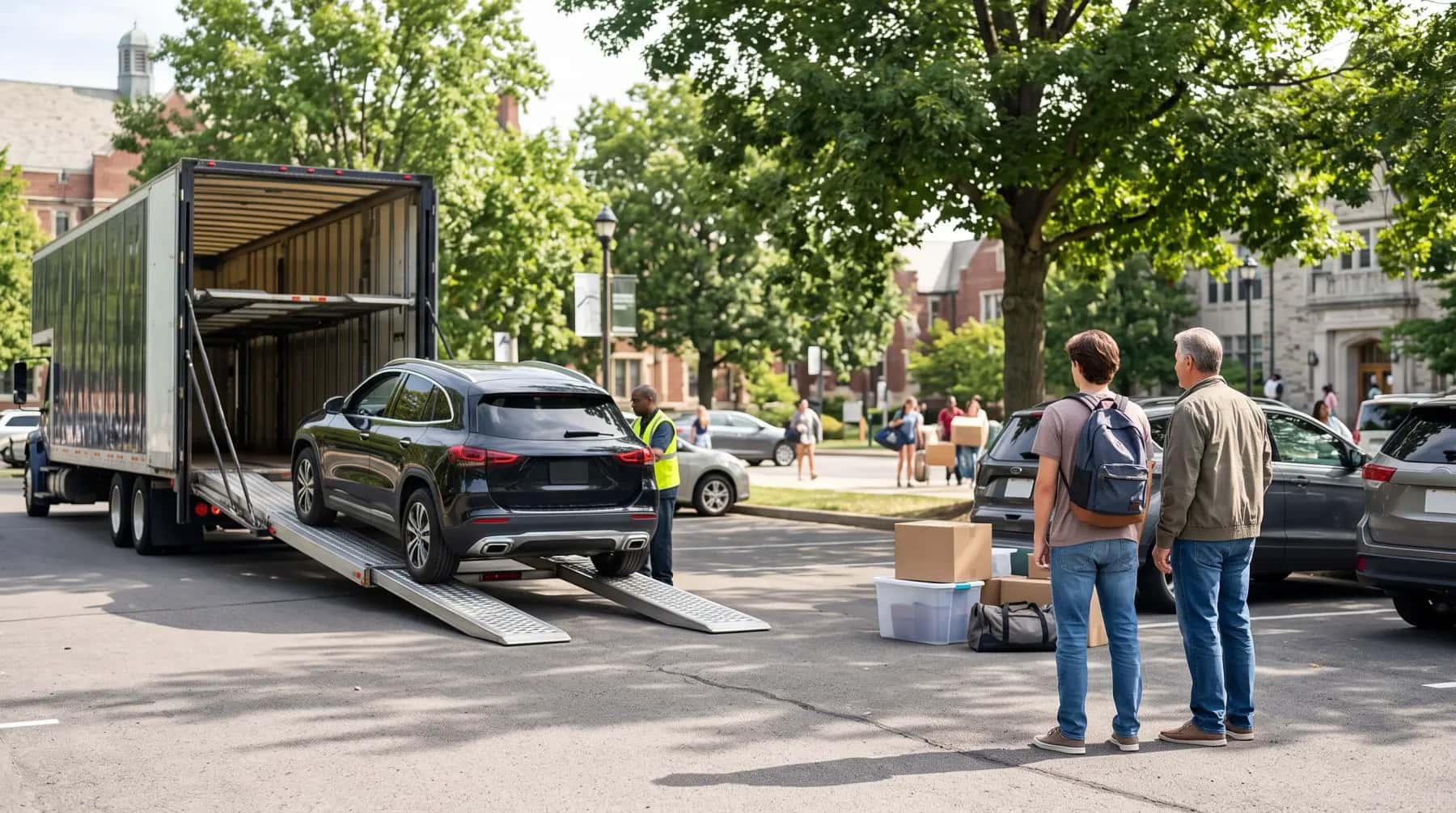
A loaded car carrier is long and heavy, and most campuses are not built for one. Dorm streets are narrow, lots have tight turns and low trees, and many schools restrict large commercial vehicles on campus roads, especially during move-in.
So most deliveries happen at the edge of campus. The driver calls the student the day before and again when close, and they agree on a meeting point, such as a large parking lot, a wide street near campus or a shopping center a short drive away. The student meets the driver there, does the walk-around and drives the car the last stretch.
Check the school's rules before delivery day. Find out where students may park, whether a permit is needed and when it is issued, and whether visitor or temporary parking is allowed while the permit is pending. Rules differ by school and sometimes by lot, so the parking or transportation office's website is the place to look.
Give your coordinator the campus address, and a suggested meeting spot if you know one, such as a lot the student will use anyway. If the student lives off campus, the apartment address may work, depending on the street.
At the meeting point, the student walks around the car with the driver, compares it with the pickup photos on the order page and notes any new damage on the bill of lading before signing.
Who does what
College orders usually involve two people in two places, and the order runs best when each knows their part.
The person who books, often a parent, enters the route and the car, signs the transport agreement and saves the card. They hold the order and receive every status email.
The pickup contact is whoever hands the car over at home. That may be the parent, the student before leaving, or a neighbor. They walk around the car with the driver, watch the photos being taken and sign the bill of lading.
The delivery contact is usually the student. Add their name and phone when you book, so the driver can reach them directly to arrange the meeting point. They inspect the car and sign the bill of lading at delivery.
Name both contacts when you book, and add the student's email so they can follow the order page too.
If anything needs a decision, reply to any status email and your coordinator answers in the same thread.
The trip home and summer storage
When the year ends, the car needs a plan, and there are usually two options.
Ship it home. Book the spring leg as a new order, with its own price, carrier and order page. Do it once the move-out date is firm, and do not leave it late, because move-out week brings the same rush to the lanes as move-in, in reverse. The student hands the car over near campus, and the parent or someone at home receives it.
Leave it near campus. Some students stay for summer classes, an internship or a job, or are back in a few months anyway, and leaving the car can save two trips. If you do, find a safe, legal place to keep it, check whether the school allows cars on campus over the summer, and keep the registration and insurance current. Trustline does not offer storage, so that part is yours to arrange.
Either way, the student should take personal items out before handing the car over, since only up to 200 lb in the trunk can travel with it.
After graduation the same choice comes back, and the car may head somewhere new, such as a first job in another state.