

The full guide
A guide to shipping a motorcycle
A motorcycle ships on the same trucks as cars, with different gear. Here is how a bike is held on the trailer, when to choose open or enclosed, how to prepare it, and what changes for trikes, sidecars and customs.
How a bike is secured
A motorcycle cannot ride a trailer on its own suspension the way a car does, so it is held upright in three ways.
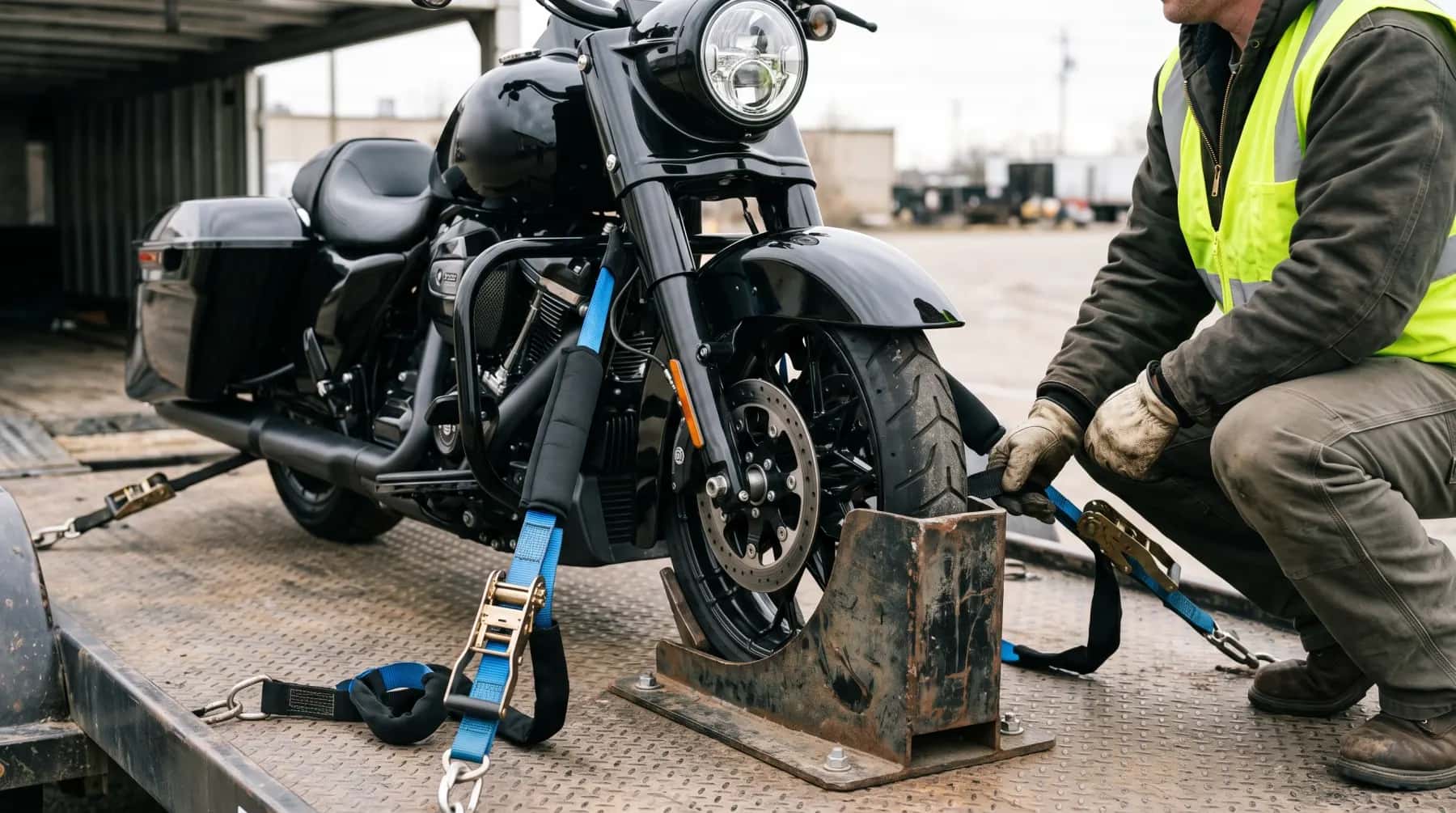
The front wheel goes into a wheel chock, a cradle fixed to the deck that grips the tire and keeps the bike pointed straight. With the wheel locked in, the bike cannot roll forward or turn.
Soft straps hold the bike down. They loop around solid points on the frame, such as the lower fork or triple clamp at the front and the frame or passenger peg mounts at the rear, and are pulled just enough to compress the suspension a little. That keeps the bike steady over bumps without straining anything.
Where the straps never go matters as much. They stay off the seat, the fuel tank, painted panels, the controls and cables, the brake lines and the wiring. Soft loops touch the bike rather than bare hooks, so metal never rubs paint.
Some owners ask for a pallet or a crate. A bike bolted to a pallet or boxed in a crate gets extra protection, mainly worth it for a show bike or a long trip with several stops. With a chock and soft straps it is rarely needed, and it adds cost, so tell your coordinator if you want it.
At pickup, the driver photographs the bike with you before it is secured, and you can watch it chocked and strapped.
Open or enclosed
Both work for a motorcycle, and the choice comes down to the bike and the weather.
Open suits most riding bikes. A standard, a sport bike or an older cruiser that already sees rain and road grit travels on an open carrier much as it would on the highway, and open costs less, with more trucks on every lane.
Enclosed suits touring bikes with large painted fairings, customs and show bikes, anything with chrome or paint you would rather not wash, and any bike crossing the northern states in winter, when road salt and slush coat everything on an open deck. Enclosed costs more and can take longer to assign, since there are fewer of those trucks.
Ask for both, and your coordinator prices them side by side so you can weigh the difference. The enclosed car transport page explains enclosed trailers in more detail.
Enclosed car transport
Preparing the bike
A little preparation makes pickup quicker and keeps the bike safe on the trip.
Fuel. Leave no more than half a tank, as the agreement requires. A quarter is plenty to ride it on and off.
Battery. Charge it fully, especially on an older bike or one that has sat. If the bike drains its battery when parked, disconnect it or show the driver how, and tell your coordinator.
Bags and covers. Take off saddlebags, tail bags, tank bags and covers, or empty hard bags and lock them shut. Anything loose can blow away or rub the paint.
Mirrors and add-ons. Fold or remove mirrors that stick out, and secure anything aftermarket that could catch a strap, such as a windshield or a light bar.
Alarm and kill switch. Turn off the alarm so it does not sound on the road, and tell the driver about any kill switch or starting trick.
Leaks. A bike that drips oil or fuel can mark the deck and anything below it. Fix what you can and tell us about the rest, since under the agreement a leaking vehicle can face extra fees or be refused.
Keys. Hand over the ignition key and any keys for the bag locks.
Photos. Take your own the day before, from both sides, with close-ups of any existing scratches.
Trikes, sidecars and customs
Not every motorcycle fits a standard wheel chock, and the right truck depends on the shape of the bike.
Trikes. A three-wheeler is wider and heavier than a two-wheel bike, and usually rides on its own wheels, strapped like a small car rather than set in a chock. Tell your coordinator the model so a carrier with room is assigned.
Sidecars. A bike with a sidecar is wide and cannot sit in a single chock, so it is strapped as one unit, and the carrier needs the width and the tie-down points. If the sidecar comes off, say whether you want it shipped attached or separately.
Choppers and long forks. A long front end may not fit a standard chock, and a raked fork changes where the straps go.
Lowered and custom bikes. A bike with little ground clearance or a low exhaust needs a gentle ramp or a lift, and custom paint may be a reason to choose enclosed.
For any of these, tell your coordinator what makes the bike different when you ask for a price, and send a photo or two if you can. The price is built around it, and the driver arrives with the right gear.