

The full guide
A guide to enclosed car transport
Enclosed transport keeps a car covered from the first strap to the last. Here is what the trailers are, which cars actually need one, how a valuable car is insured, and how the timing differs from open.
What an enclosed trailer is
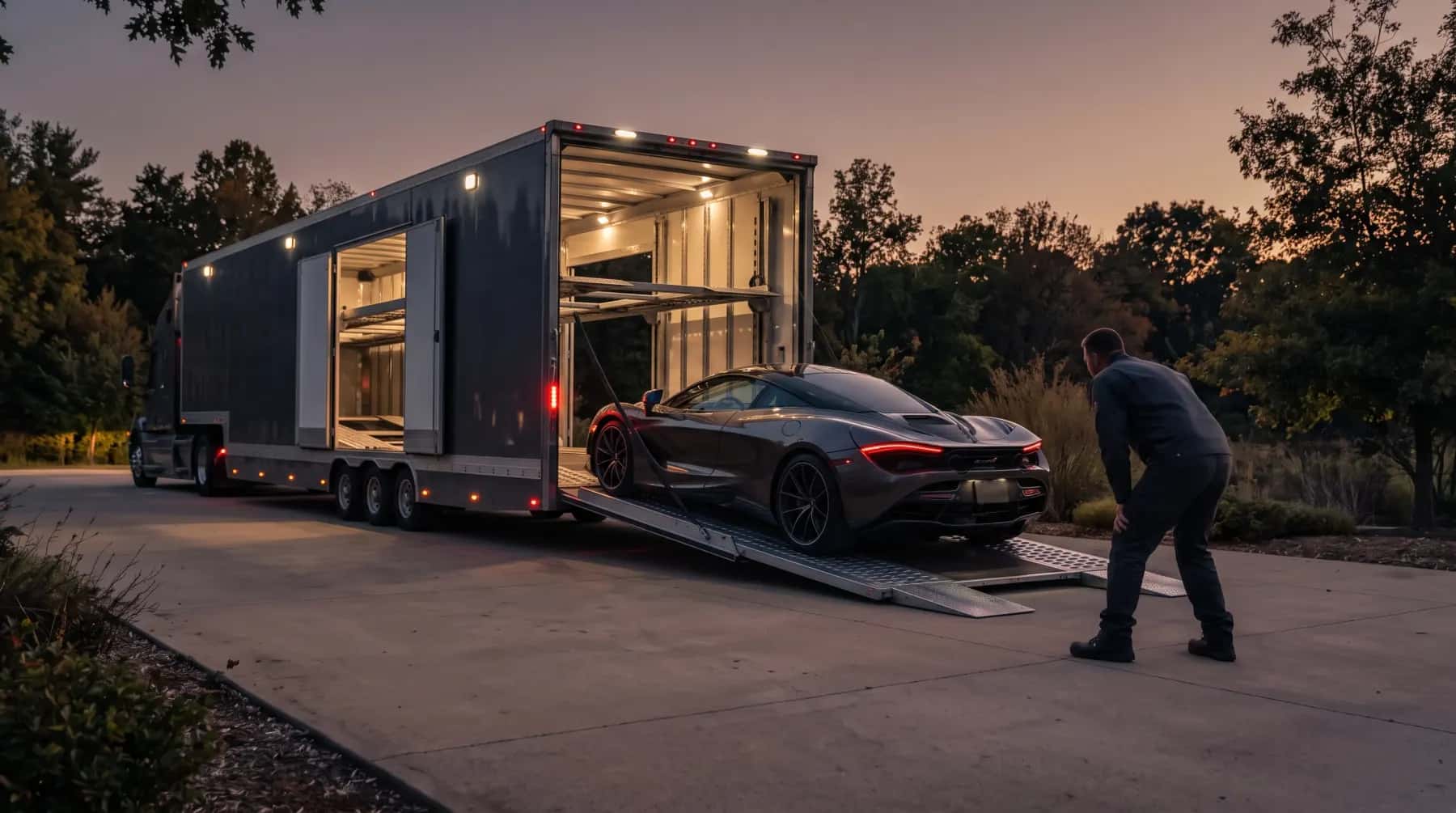
An enclosed trailer is a box on wheels. The car rides inside, with walls and a roof between it and the weather, the road, and anyone with a phone camera at a rest stop.
Two kinds run most lanes. A soft-sided trailer has heavy curtain walls over a frame. It keeps out rain, grit and stone chips, and it is the more common of the two. A hard-sided trailer has solid walls and a solid roof, which add protection against impact and make it the usual pick for very high-value cars. If you need one or the other, say so when you book.
Size varies too. A one-car or two-car trailer, often pulled by a heavy pickup, gives a single car a lot of attention and can reach tighter streets. A larger multi-car trailer, sometimes on two levels, runs the long interstate routes.
Loading is where enclosed earns its keep for low cars. Many enclosed trailers use a hydraulic lift gate, a platform that raises the car level with the deck, so a splitter or a low exhaust never meets a steep ramp. Others use long, low-angle ramps.
Inside, cars are usually held by soft straps around the wheels, with chocks to stop them rolling. The car is driven or winched aboard, and the engine stays off for the trip.
Which cars should go enclosed
Enclosed earns its higher price when damage would cost more than the difference, or when the car cannot ride open at all.
By car, that means a classic or antique with original paint, an exotic or high-end sports car, a fresh restoration or new paint still curing, a convertible with a fabric top you would rather not test, and anything low enough to scrape on a ramp. Cars with a splitter, side skirts or a low exhaust need the lift gate or low ramps even more than the cover.
By situation, it means a car heading to a show, an auction or a buyer, where it has to arrive clean and unmarked. A winter move across the northern states, where salt and slush coat everything on an open deck. A car you just bought and want to see spotless at the first handover.
Open is enough for a daily driver, a work truck, a family SUV or an older car that already lives outside. If rain and road dust would not bother you on a highway drive, they will not bother you on an open trailer, and open costs less and usually picks up sooner.
If you are on the fence, price both. Your price screen shows open and enclosed side by side, so the choice comes down to a number you can see.
Open car transport
Insurance and the car's value
Every carrier on a Trustline order carries cargo insurance, and we check that its certificate is current before the carrier is assigned. While your car is on the truck, it is insured under that carrier's cargo policy.
The number that matters is the limit, and it applies per load. The transport agreement puts carrier cargo cover at $100,000 to $250,000 per load, so on a trailer carrying several valuable cars, that limit is shared among them. Enclosed carriers often carry higher limits than open ones, which is part of why they suit expensive cars.
So tell us what your car is worth when you book, and we look for a carrier whose cargo limit fits it.
Cargo policies also have edges. Personal items left in the car are not covered. Many policies carry a deductible, and some exclude certain kinds of damage. The agreement itself notes that carrier insurance can have exclusions and gaps, and suggests checking your own cover.
For a car worth more than a typical cargo limit, or one you could not replace, call your own insurer before the move. Many collector and agreed-value policies cover a car in transit, and single-trip transit cover can often be bought. It is a short call, and it closes the gap a carrier's policy can leave.
If something does happen, note it on the bill of lading at delivery and photograph it before the driver leaves. Then send the claim in writing within 15 days, and we give you the carrier's registration and insurance details to make it.
Timing
Enclosed trucks are fewer than open ones on most lanes, so assigning a carrier can take a day or two longer. Once the car is loaded, the days on the road are about the same, at about 400 to 500 miles a day. Miami to Los Angeles, about 2,847 miles, is 6 to 8 days on the truck.
Give it more lead time than you would for open. Booking a week or two ahead gives your coordinator room to find the right trailer, especially if you need a lift gate or a hard-sided one.
The busy seasons hit enclosed harder. Snowbird traffic fills the southbound lanes from October to December and the northbound lanes from March to May, and the spring and fall show seasons pull enclosed trucks toward the big events.
A few days of slack on the pickup date helps more here than anywhere, because it lets more of the few enclosed carriers on a lane fit your car in. For a date that cannot move, the guaranteed pickup date option fixes it.