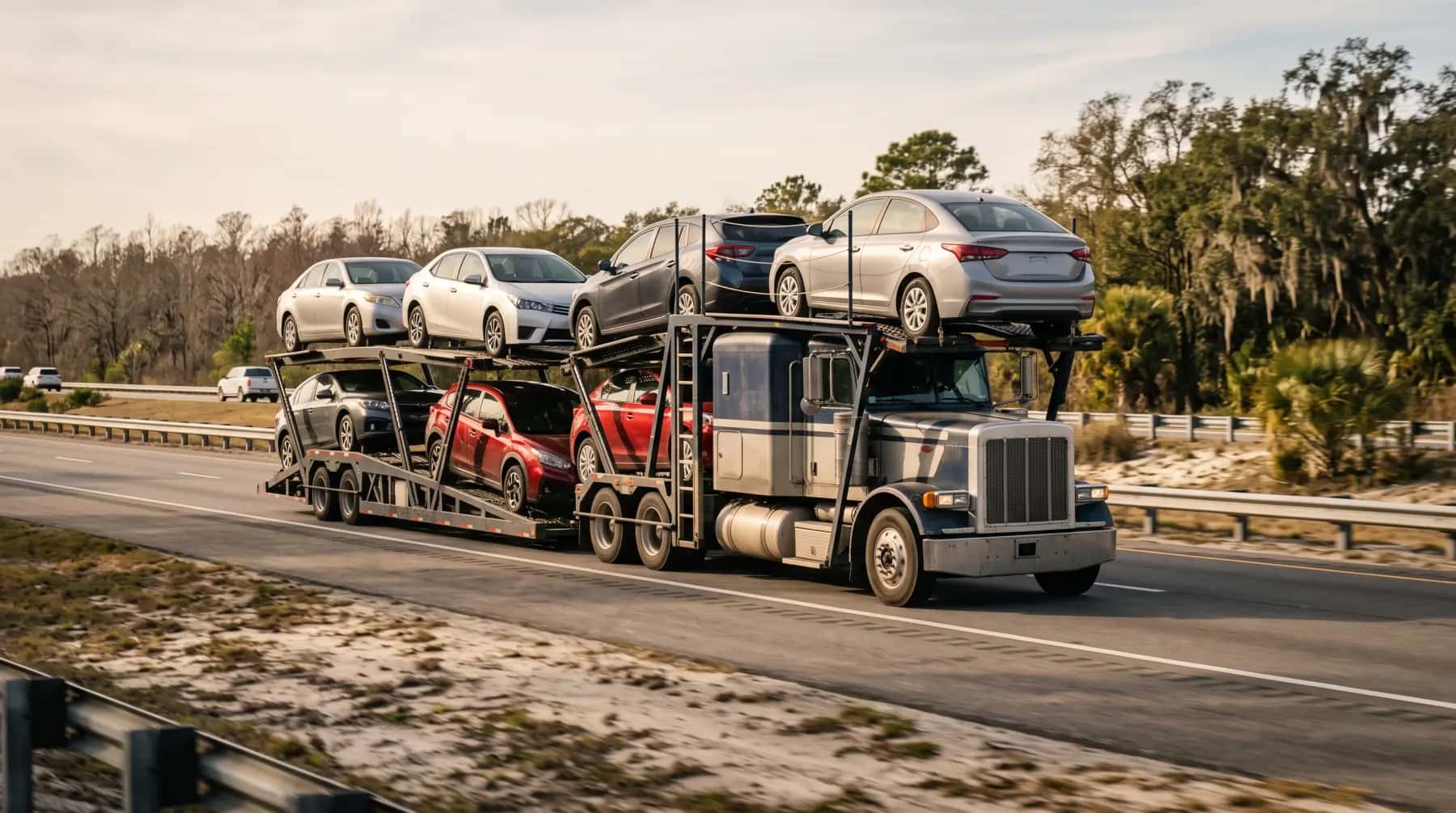
Shipping time has two parts. First a carrier has to be assigned, which takes 1 to 5 days on most lanes. Then the car is on the truck, and carriers cover 400 to 500 road miles a day. Add the two and you have a realistic window.
The two clocks
The pickup window is the time between booking and loading, usually 1 to 5 days. Transit is the time on the truck. Your price screen shows both before you book, and the order page keeps them in front of you afterwards.
Take a car booked on a Monday for a run of about 1,000 miles. The first day it can go is Tuesday. A carrier on the lane takes it on Wednesday and loads it Thursday. That is 2 days of pickup window. The car then covers the 1,000 miles in 2 to 3 days, so it arrives on Saturday or Sunday. From booking to delivery, 5 to 6 days.
You hear about each change as it happens. An email goes out when the carrier is assigned, when the car is picked up, while it is on the road and when it is delivered. The order page shows the same status at any hour.
Transit days by distance
These are days on the truck once the car is loaded, at 400 to 500 road miles a day. They do not include the pickup window.
| Road miles | Days on the truck | Example |
|---|---|---|
| About 500 | 1 to 2 days | Orlando to Atlanta, Dallas to Houston and back |
| About 800 | 2 days | Chicago to Nashville, Dallas to Denver |
| About 1,000 | 2 to 3 days | New York to Orlando, Chicago to Dallas |
| About 1,200 | 3 days | Chicago to Orlando, Boston to Orlando |
| About 2,000 | 4 to 5 days | Orlando to Denver, Chicago to Los Angeles |
| About 2,800 | 6 to 7 days | Los Angeles to New York, Miami to Seattle |
A driver's day has a legal limit, and a car carrier also stops to load and unload the other cars on the trailer. That is why a 1,000-mile run takes 2 or 3 days rather than the 15 hours a map app shows. Miles are road miles between the two addresses, which is also what sets the price.
What moves the pickup window
The pickup window depends on how many trucks run your lane that week against how many cars are waiting. Busy lanes between big cities fill fastest, because carriers run them every week and can fit one more car. A pickup in a small town off the interstate waits for a truck that is going that way anyway, or for a carrier willing to detour.
Three things stretch the window. A car that does not run needs a carrier with a winch, and fewer trucks carry one. An enclosed trailer carries fewer cars, so there are fewer of them on any lane. And a fixed first day with no slack gives carriers only one day to fit you in. The season matters too. From October to December the southbound lanes to Florida fill early, and from March to May the northbound ones do.
The easiest way to shorten the window is to give it room. If your car can go any day from Monday, say Monday, and a carrier passing on Wednesday can take it. If it can go only on Wednesday, only the carriers passing on Wednesday can.
Paying for a faster pickup
Two options at booking change the pickup. Each is a visible line on your order and on the agreement, and neither promises a delivery date.
A guaranteed pickup date fixes the day. You choose it when you book, it is written into the agreement, and the carrier collects the car on that day. It costs $200, which is part of the reservation and is refunded if the carrier misses the date. It covers the pickup date only. Delivery stays an estimate, because the road does not take bookings.
Expedited dispatch gets your car in front of carriers first, at a higher carrier rate, so it is usually taken sooner. It costs $350, added to the amount paid to the carrier at delivery. It shortens the wait, but it does not fix a day, so if you need a specific date, the guaranteed pickup is the one to choose.
Knowing the delivery day
Once the car is loaded, the driver gives an expected delivery window and your order page shows it. On the day, the driver calls ahead, usually a few hours out, so you or the person you named can be there to walk around the car and sign the bill of lading.
If anything changes on the way, weather, a breakdown or a late stop, you hear it from us by email and from a coordinator by phone before you have to ask. The delays guide explains why dates move and what we do when they do.
 Trustline CarriersLicensed broker · MC 1661496